Bestessaytips.com Review
Bestessaytips.com is an online service for ordering essays and other types of students’ home assignments. The company is quite new, but it’s getting more and…
Read articleThe Split-Order Test: WriteMyPaperBro.com Under a Controlled Review
WriteMyPaperBro.com





Bestessaytips.com Review
Bestessaytips.com is an online service for ordering essays and other types of students’ home assignments. The company is quite new, but it’s getting more and…
Read article
Ultius.com Review
Ultius is one of the top rated custom writing services that hires exceptionally professional authors. The company has a big database of customers all over…
Read article
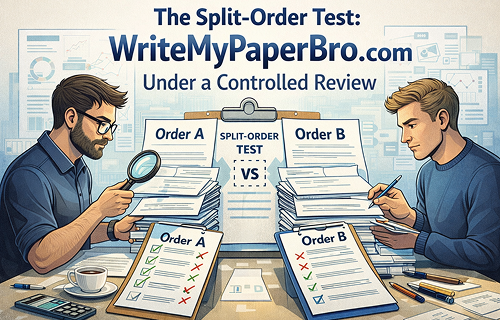
I’ve been reviewing academic writing services for long enough to know that a single order tells you almost nothing. One good delivery proves a service can perform once. What you really want to know is whether quality is a system or an accident. So this time I ran a controlled split: same prompt, same deadline, two different writers, zero communication between them. I watched everything – response speed, tone of pre-order chat, structural choices, citation habits, how each person handled ambiguity. What I found on WriteMyPaperBro was genuinely interesting, and not in a way I expected going in.
The Assignment I Chose and Why It Was Designed to Expose Weaknesses
The topic I chose was deliberate: a 1,200-word argumentative essay on whether universal basic income would structurally reduce labor market participation, with a requirement to engage at least one economic counterargument seriously and cite peer-reviewed sources. Not a hot-take essay. Not a five-paragraph high school thing. Something that requires the writer to actually hold two conflicting positions in their head at once and produce something coherent from the tension.
I posted the brief on WriteMyPaperBro.com on a Wednesday morning. Within the first hour, eleven bids came in. I selected two writers based on a shortlist of five – not by price, not by rating alone, but by the quality of their opening messages. I’ll explain exactly what I was looking for.
The Shortlisting Criteria I Actually Used (Not the Ones That Sound Logical)
Most students look at star ratings. I look at how a writer phrases uncertainty. Anyone who opens with “I can definitely handle this, no problem” goes to the bottom of my list immediately – because UBI labor market literature is genuinely contested, and false confidence is a tell. What I’m looking for is something closer to: “I’d probably structure this around the substitution effect critique first – does that match what your professor is expecting?” That kind of message shows the person read the brief, understands the intellectual stakes, and is thinking about the argument rather than the transaction.
“The two writers I selected – I’ll call them Author A and Author B throughout – cost $76 and $89 respectively for the same 1,200-word brief with a 60-hour deadline.”
Author A (the $76 bid) opened with a question about whether I wanted the essay to land on a clear position or maintain analytical neutrality. Author B ($89) immediately mentioned Daron Acemoglu’s 2019 work on automation and labor substitution. Both signals I respected. Both writers accepted. Neither knew about the other.
WriteMyPaperBro Timeline – Every Exchange, Every Doubt, Every Minute That Mattered
Wednesday, mid-morning
Brief posted on WriteMyPaperBro. Eleven bids within the first hour. I shortlisted five, messaged three, selected two. Total active attention: about 25 minutes.
Wednesday, early afternoon
Author A blinked first. Asked whether “labor market participation” meant formal employment or broader economic activity including informal work. That’s exactly the kind of clarifying question that separates someone thinking about your essay from someone who just accepted a job. I confirmed: formal employment, OECD definition.
Wednesday, evening
Author B still quiet. No clarifying questions, no check-in. I sent a message asking if they had any questions about the prompt. Response came 90 minutes later: “I’ve started working on it, should be fine.” Noted. Not a red flag exactly, but a yellow one.
Thursday, late morning
Author A sent a draft outline unprompted – three paragraphs summarizing the argument structure. I hadn’t asked for this. It showed they were building toward something deliberate rather than just filling a word count. I wrote back: “Looks good, proceed.”
Thursday, late afternoon
Author B delivered. Eighteen hours before deadline, which initially sounds impressive. I opened the file with the specific skepticism that early delivery sometimes earns – sometimes it means the writer worked fast and well; sometimes it means they wrote whatever came to mind and stopped.
Friday, early morning
Author A delivered. Both papers now in hand. The real work begins.
Two Papers, One Prompt – The Comparison Nobody Usually Does This Carefully
I read both papers twice before taking notes, which is a rule I set for myself years ago. First read is impressionistic. Second read is forensic. Here’s what the forensic pass found.
Author B’s paper read well at first. This is a genuine trap in essay evaluation – fluent prose creates the impression of depth. But fluency and rigor are not the same thing, and the counterargument section collapsed on close reading. “Some economists argue UBI could reduce work incentives, but evidence from pilot programs suggests otherwise” is not engaging a counterargument. It’s acknowledging one exists and moving on.
“Author A’s paper had one paragraph that genuinely surprised me – a distinction between short-run labor participation effects and long-run reallocation toward more productive sectors. That’s a substantive analytical move that wasn’t in the brief.”
The Citation Problem – Why One Forbes Link Changed Everything
The brief specified peer-reviewed sources. This isn’t ambiguous. A Forbes opinion piece – regardless of the author’s credentials – is not peer-reviewed. Author B included one, and while the paper still functions without it, the inclusion signals one of two things: either the writer doesn’t know the difference between peer-reviewed and high-quality journalism (a knowledge gap), or they do know and included it anyway because it was convenient (a professionalism gap). Neither is good. I flagged this in a revision request. Author B replaced it within four hours, no argument. Which is something.
What WriteMyPaperBro Gets Right That Most Services Don’t Talk About
The escrow system is standard in this industry but worth mentioning because it changes the psychology of ordering. You’re not sending money into a void – the platform holds it until you confirm delivery. I tested this by asking support what happens if a writer delivers something completely off-brief. The answer was specific and procedural: revision request first, then mediation if unresolved, then refund evaluation. Response time on that question: nine minutes on a Thursday afternoon.
The bidding pool on WriteMyPaperBro also appears to have a real range of specializations. Two of the writers who bid and didn’t make my shortlist had profiles specifically listing labor economics and public policy – relevant to my brief. I didn’t choose them for other reasons, but the pool isn’t just generalists. That’s a meaningful difference from services where every writer claims to cover “all subjects.”
The One Moment That Made Me Trust the Service More Than I Expected To
When Author B delivered the paper with the Forbes citation, I flagged it not through the revision system but directly via the platform’s support channel – I wanted to see how they handled a quality complaint about a completed order. The response acknowledged the issue without becoming defensive about the writer, explained the revision pathway clearly, and didn’t try to reframe the problem as my misunderstanding of the brief. That’s rarer than it sounds. Most support interactions in this industry involve some version of “our writers are very experienced” as a deflection. This one didn’t.
WriteMyPaperBro: The Honest Ledger
Author A – $76 – The one I’d order from again: Engaged with the brief before writing, asked smart clarifying questions, delivered an analytically structured paper with a genuine original observation, cited correctly, landed within word count. The prose was occasionally stiff but the thinking was sound.
Author B – $89 – Worth knowing about, with conditions: Fluid writer, responsive to revision, but the initial delivery cut corners on the counterargument and included a non-qualifying source. If you need polished prose and aren’t writing for a rigorous academic course, Author B might actually suit you better. If you need intellectual rigor, Author A at $76 outperformed at $13 less.
The price gap matters here not because $13 is a lot of money, but because it inverts the assumption most students carry into a service. Higher bid does not reliably mean better thinking. It might mean more confident self-presentation, a different client target, or simply a different pricing philosophy. The only way to know is to do what I did – which most students understandably won’t, which is exactly why running this experiment was worth documenting.
FAQ
Q1: If Author A was cheaper and better, does that mean premium bids on WriteMyPaperBro are just overpriced confidence?
Price on bidding platforms reflects self-assessment more than verified skill. The pre-order chat is your real pricing mechanism – not the number in the bid.
Q2: Is the short-run vs. long-run distinction that Author A introduced actually a recognized debate in UBI literature?
Yes, and it’s a recognized tension in UBI research. Short-run participation drops are well-documented; whether they represent permanent change or transitional reallocation is still contested in macro labor economics.
Q3: What makes a Forbes article disqualifying when a Forbes contributor might have a PhD and published research?
The issue is process, not credentials. Peer-reviewed means anonymous expert evaluation before publication – an opinion column, however well-written, has bypassed that entirely.
Q4: Could the quality gap between the two writers have been reversed with a different topic – say, something more literary than economic?
Probably yes – subject-writer fit matters more than most students account for. The diagnostic method transfers across topics even when specific conclusions don’t.
Q5: If you ran this same experiment on WriteMyPaperBro with a STEM topic instead of social sciences, would the evaluation criteria change significantly?
Substantially, yes. You’d swap counterargument evaluation for methodological accuracy checks, and add a specific calculation problem to the pre-order screening. The underlying principle stays the same; the instruments change.